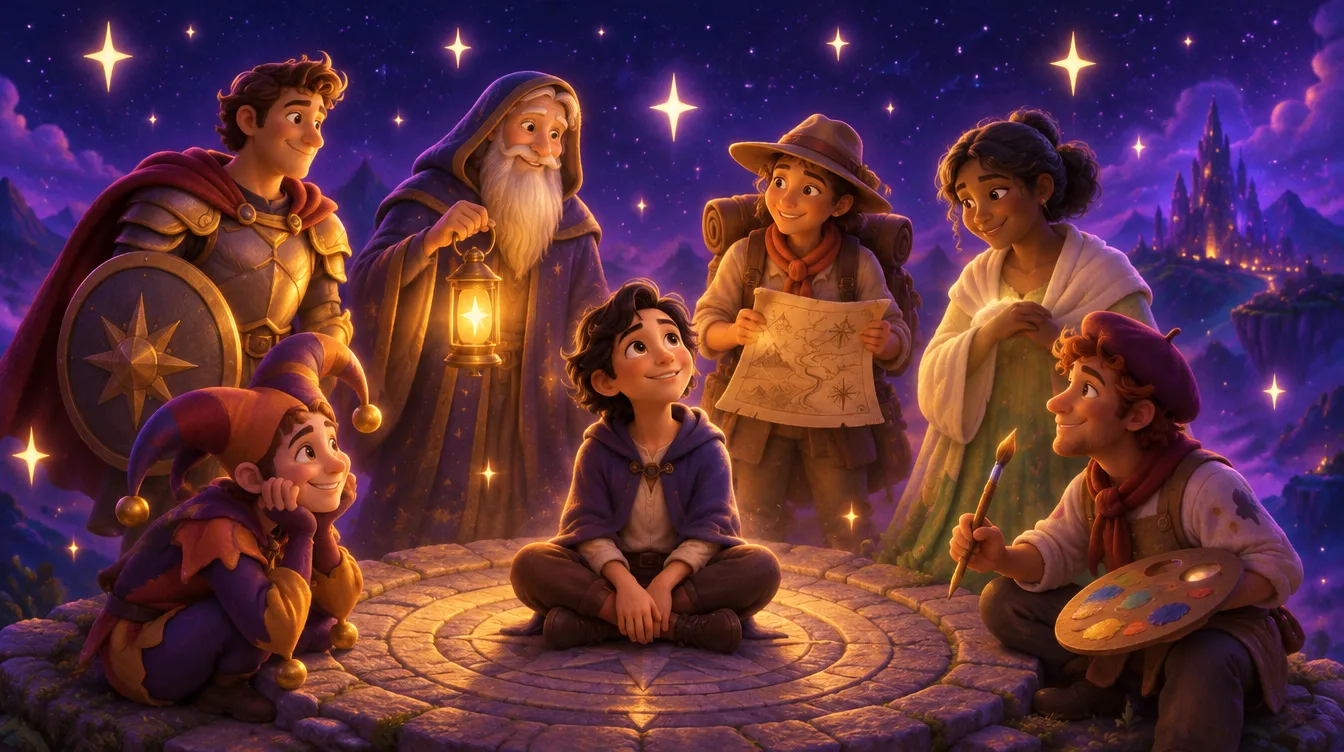
Some characters we love in films, myths and stories feel familiar before we can say why. The white-bearded sage. The reluctant hero who accepts the call. The caregiver who gives themselves. The rebel who breaks what has to break. Carl Gustav Jung, the Swiss psychiatrist, spent much of his life on a bold hypothesis to explain that familiarity: there would be universal figures inside each of us, inherited collectively, shaping our inner lives.
What Jung proposed — in plain language
Jung was Freud's dissident student. While Freud insisted the unconscious was personal — made of what our history hid — Jung proposed a deeper layer: the collective unconscious, a substrate shared by the whole human species, made not of memories but of archetypes. An archetype, for Jung, is an empty form — a disposition to recognize, imagine, and live certain patterns: the hero, the mother, the shadow, the wise old man, the trickster.
These archetypes show up in dreams, in myths, in fairy tales from peoples who never met, in works of art and — for what matters here — in the way each person lives their phases, their relationships, their crises.
An honest note before continuing
The Jungian model doesn't have the empirical base of the Big Five, nor the well-established cross-cultural validity of OCEAN. It's a deeply inspired body of work, full of valuable intuitions, but also of claims contemporary psychology treats with caution. Use the archetypes as a poetic language to think about yourself, not as a diagnosis or a final explanation. That said, few vocabularies are as useful when the topic is personal history, life choices, and meaning.
The twelve archetypes, with voice and setting
Later work — especially Carol Pearson's — systematized twelve archetypes common in post-Jungian literature. Each has a central desire and an opposite fear.
The Innocent. Wants simplicity and clean happiness. Fears corruption and disillusionment. Sees the world with morning eyes.
The Sage. Wants truth and understanding. Fears ignorance and deception. Withdraws to think, returns with maps.
The Explorer. Wants freedom and authenticity. Fears imprisonment and conformity. Packs before being asked.
The Hero. Wants to prove worth through brave acts. Fears weakness and defeat. Feels alive in causes larger than itself.
The Rebel (Outlaw). Wants revolution, rupture, change. Fears powerlessness. Breaks what needs to be broken.
The Magician. Wants to understand and transform. Fears unintended consequences. Works with the invisible.
The Everyman. Wants belonging without pose. Fears standing out. Keeps the world running without fuss.
The Lover. Wants intimacy and beauty. Fears loneliness and rejection. Finds the sacred in encounter.
The Jester. Wants joy and the present moment. Fears boredom and cynicism. Laughs first, and so teaches.
The Caregiver. Wants to protect and serve. Fears selfishness and neglect. Knows what the other doesn't know yet.
The Ruler. Wants control and thriving order. Fears chaos and collapse. Builds durable houses.
The Creator. Wants to make something of lasting worth. Fears mediocrity. Lives with an image that keeps insisting on being born.
Nobody is a pure archetype. There's usually a dominant one, one or two secondary, and a shadow — the archetype we reject and which, for that reason, acts on us behind our back.
The shadow: a necessary discomfort
A Jungian concept worth naming: the shadow is the set of qualities you don't recognize in yourself, usually because they were condemned early. Jung said that integrating the shadow — no longer denying it, giving it conscious room — is one of the most important tasks of adult life. What we push away hardest tends to rule us in secret.
When the test tells you your dominant archetype is the Sage, also pay attention to the one with the lowest score. That's often where your shadow lives — and with it, a piece of your freedom.
An invitation
This test is different from the others. Less scientific, more poetic. It doesn't return a number that predicts your performance; it returns an inner figure you probably already knew without knowing. Use it the way one uses a good myth: not to explain everything, but to recognize what was already living inside you and asking for a name.